
Uncategorized
Furniture Size for HDB: The Mistake Most Homeowners Make
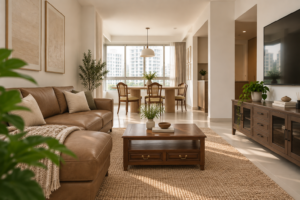
Choosing furniture for an HDB flat is not simply about finding pieces that fit inside the room. The bigger challenge is choosing furniture that feels proportionate to the space.
A sofa may technically fit against the wall, but if it is too deep, the living room can feel cramped. A dining table may accommodate the whole family, but if there is barely enough space to walk around it, everyday life becomes uncomfortable.
This is one of the most common furniture mistakes HDB homeowners make: buying furniture based on whether it fits, instead of how it fits into the overall space.
HDB layouts vary considerably, but many homes have carefully planned living and dining areas where furniture placement directly affects movement and functionality. HDB’s own floor-plan examples show suggested furniture layouts within different flat types, highlighting how the same room needs to accommodate seating, dining, circulation and other functions.
The good news? You do not need a completely minimalist home to make your HDB feel spacious. You simply need to get the scale, proportions and placement right.
The Biggest Mistake: Choosing Furniture That Is Too Large
The most obvious furniture size mistake is choosing pieces that are simply too big.
It often happens when homeowners shop based on photographs.
A large sectional sofa might look beautiful in a spacious showroom. A substantial solid wood dining table may look impressive in a large landed home. But when the same furniture enters a compact HDB living room, the result can be very different.
The furniture might fit physically, but the room starts to feel crowded.
This is especially important with solid wood furniture. Solid wood pieces naturally have visual weight, so a large wooden cabinet or dining table can make a room feel heavier than a similarly sized piece with a slimmer construction.
Instead of asking:
“Can this furniture fit?”
Ask:
“Will this furniture leave enough space for the room to breathe?”
That small change in thinking can completely change the way you furnish your home.
Think About Furniture Scale, Not Just Measurements
When choosing furniture for an HDB flat, measurements are only part of the equation.
Two sofas can have almost the same width but feel completely different in a room.
For example, a sofa with:
- Thick armrests
- Deep seating
- A high back
- A solid base
- Dark upholstery
will generally feel visually heavier than a sofa with:
- Slim arms
- Moderate depth
- A lower profile
- Visible legs
- Lighter upholstery
This is why scale matters as much as size.
A piece can have the right measurements but still overwhelm the room visually.
For HDB homeowners, this is particularly important when combining several major pieces, such as a sofa, coffee table, TV console, sideboard and display cabinet.
If every piece is large and visually heavy, the room can quickly feel smaller.
Measure the Sofa’s Depth, Not Just Its Width
One of the easiest mistakes to make is focusing only on sofa width.
Imagine you have a wall that can accommodate a 220 cm sofa. You might assume that any sofa under 220 cm will work.
But what if the sofa is 100 cm deep?
That extra depth can significantly reduce the usable floor area in front of it.
Before buying a sofa, measure:
- Width
- Depth
- Height
- Armrest width
- Clearance around the sofa
For a compact HDB living room, a slightly shallower sofa can sometimes be a better choice than a larger, deeper model.
The goal isn’t necessarily to buy the smallest sofa.
It is to choose the largest sofa that still allows comfortable movement around it.
Your Coffee Table Can Make or Break the Layout
The coffee table is another piece that is often underestimated.
A coffee table that is too large can make the space between your sofa and TV feel compressed. A table that is too small, however, may look disconnected from the sofa.
As a starting point, aim to leave approximately 40–45 cm between the sofa and coffee table. This gives your legs some space while keeping the table close enough to reach comfortably.
The shape can also make a difference.
For tighter HDB layouts, consider:
- Round coffee tables
- Oval coffee tables
- Nesting tables
- Smaller rectangular tables
- Ottomans that can serve multiple purposes
A round or oval table can sometimes make circulation feel easier because there are no sharp corners interrupting the walking path.
Don’t Fill Every Empty Corner
Another common mistake is thinking that an empty corner means something is missing.
It doesn’t.
Sometimes, empty space is what makes a room feel finished.
Homeowners may add:
- Another side table
- A large display cabinet
- Extra chairs
- Decorative shelves
- A second storage unit
because a particular corner feels empty.
But once everything is added, the room can become visually crowded.
Instead, ask whether the piece serves a real purpose.
If you already have sufficient storage, you may not need another cabinet simply because there is an available wall.
If the living room already has a substantial sofa and coffee table, adding another large occasional chair may not improve the space.
Good interior design is not about filling every available square metre.
It is about giving every piece enough space to be appreciated.
Don’t Forget Your Dining Area
The same furniture size mistake happens in HDB dining spaces.
A large dining table can look impressive, but the chairs also need space around them.
Think beyond the tabletop itself.
You need to account for:
- Chair depth
- Space behind dining chairs
- Walking paths
- Access to nearby cabinets
- Movement between the kitchen and dining area
A dining table may technically fit, but if someone has to squeeze behind a chair every time another person sits down, the table is too large for the layout.
This is particularly important in open-plan HDB homes where the dining area shares space with the kitchen and living room.
The dining table should work with the entire room, not exist as an isolated piece.
Large Storage Furniture Needs Extra Planning
Storage furniture is extremely useful in Singapore homes, but it can also create one of the biggest visual problems.
A tall display cabinet, sideboard or chest of drawers can provide valuable storage while adding character to the room.
But placing several substantial storage pieces together can make the walls feel crowded.
For example, imagine a living room with:
- A large TV console
- A full-width sideboard
- A tall display cabinet
- A large sofa
- A substantial coffee table
Individually, each piece may look beautiful.
Together, they may be too much.
Instead, choose one or two pieces to become the visual focus.
This is particularly effective with solid wood furniture because the natural grain and substantial construction already give the furniture a strong presence.
Consider Visual Weight When Choosing Solid Wood Furniture
Solid wood furniture can be an excellent choice for HDB homes because it brings warmth, texture and character into contemporary interiors.
But it needs to be selected carefully.
A dark mahogany sideboard, for example, will naturally have more visual presence than a light-coloured cabinet with a slim frame.
That doesn’t mean you need to avoid darker or heavier furniture.
Instead, balance it.
Pair a substantial wooden piece with:
- Lighter upholstery
- Open floor space
- Neutral walls
- Natural light
- Slimmer furniture
- Soft textiles
- Simple decorative elements
This creates contrast and prevents the room from feeling too heavy.
The same principle applies when styling British Colonial furniture in a modern HDB home. The traditional richness of mahogany can become a beautiful focal point when balanced with lighter colours and contemporary surroundings.
The “Showroom Test” Doesn’t Always Work
Furniture showrooms are designed to make products look appealing.
They often have:
- High ceilings
- Large floor areas
- Professional lighting
- Carefully controlled layouts
- Fewer competing objects
Your HDB is different.
You have doors, windows, built-in cabinetry, electrical points, TV units, air-conditioning, dining areas and everyday belongings.
So don’t judge furniture only by how it looks in a showroom.
Instead, imagine the entire footprint of the piece inside your own home.
A useful trick is to use masking tape on your floor.
Mark the exact dimensions of the sofa, dining table or cabinet you are considering.
Then walk around it.
Open imaginary drawers.
Pull out dining chairs.
Walk from the entrance to the living room.
Stand between the sofa and coffee table.
You’ll quickly discover whether the furniture works with your lifestyle.
Measure Before Buying Furniture for Your HDB
Before ordering a large furniture piece, measure more than just the room.
Check:
1. The room
Measure the available wall and floor space.
2. Doorways
Check whether the furniture can physically enter the room.
3. Lift access
For apartment living, don’t forget to consider how large furniture will be transported to your floor.
4. Hallways
A piece may fit through the main door but still struggle around a narrow corridor or corner.
5. Windows and doors
Make sure furniture doesn’t interfere with doors opening or block important windows.
6. Existing furniture
Measure the furniture that will remain in the room.
7. Walking paths
Mark the main routes you use every day.
This is especially important when planning a renovation or major furniture purchase. HDB advises homeowners to understand the relevant renovation guidelines and requirements before carrying out renovation works.
What Size Furniture Should You Choose?
There is no single furniture size that works for every HDB flat.
A 3-room flat, 4-room flat and 5-room flat can have very different layouts. Even two flats with the same number of rooms can have different configurations.
HDB’s published layouts demonstrate this variation, with different flat types offering different living and dining arrangements.
Instead of following a rigid furniture-size formula, use these principles:
Choose the largest piece only when the room can comfortably support it.
Leave enough space for people to move naturally.
Balance heavy furniture with lighter elements.
Consider depth as carefully as width.
Don’t fill every empty corner.
Think about the entire room, not individual furniture pieces.
How to Make Large Furniture Work in an HDB
If you love substantial furniture, you don’t necessarily have to choose small pieces.
The trick is to create balance.
For example, a large solid wood dining table can work beautifully in an HDB dining area if the surrounding furniture is kept relatively simple.
A substantial mahogany sideboard can become a statement piece when the wall around it isn’t overloaded with decoration.
A large sofa can work when the coffee table is appropriately sized and the main walking path remains clear.
In other words, one impressive piece is often better than five competing pieces.
This is where well-made solid wood furniture can be particularly effective. Instead of filling your home with numerous smaller pieces, one thoughtfully chosen piece can provide function, warmth and personality.
The Best HDB Interiors Are Not Necessarily the Most Minimal
There is a misconception that small HDB homes need to be completely minimalist.
That’s not necessarily true.
A home can have rich wood furniture, decorative objects, artwork and comfortable seating while still feeling spacious.
The difference is proportion.
When the furniture is appropriately scaled to the room, the home feels intentional rather than crowded.
You don’t need to remove everything you love.
You need to choose pieces that work together.
Before You Buy Your Next Furniture Piece
Before purchasing your next sofa, dining table, cabinet or sideboard, take a few minutes to ask yourself:
Does it physically fit?
Does it leave enough walking space?
Is the depth suitable for the room?
Will it visually overwhelm my existing furniture?
Can doors and drawers open comfortably?
Does it block natural light?
Does it make sense for how I actually use the room?
Will I still like the layout after adding my everyday belongings?
If the answer to these questions is yes, you are much more likely to end up with a home that feels comfortable rather than simply furnished.
It’s Not About Having a Smaller Home
The biggest furniture size mistake HDB homeowners make is assuming that the solution to a compact home is simply buying smaller furniture.
That’s not always the answer.
The better approach is to understand proportion, scale, spacing and visual weight.
A well-sized sofa can make a living room feel open. A carefully chosen dining table can make an open-plan area feel balanced. A substantial solid wood sideboard can become a beautiful focal point without overwhelming the room.
The goal is not to make your HDB look empty.
The goal is to make every piece feel like it belongs there.
At Home of Homes, carefully selected solid wood furniture can help Singapore homeowners create interiors that feel warm, timeless and considered — whether you are furnishing a new HDB flat or refreshing the home you have lived in for years.
Explore furniture designed to bring character and lasting style into your Singapore home at: https://www.homeofhomes.com.sg/