
Uncategorized
How Long Should Your TV Console Be? HDB Size Guide?
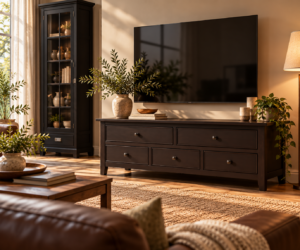
A TV console can look perfectly fine in a showroom and completely wrong once it enters your living room.
Sometimes the problem is obvious. The console is simply too large for the space.
More often, however, the issue is proportion.
The TV might be large, but the console is too short. Or the console fits the wall but leaves awkward gaps around the TV. In a smaller HDB living room, even a few extra centimetres can make the entire arrangement feel heavier than it needs to.
So how long should your TV console actually be?
The answer is not simply, “Buy a console that fits your TV.”
The better approach is to consider the actual width of your TV, the width of the wall, the viewing area and the furniture around it.
This is the proportion rule that many homeowners miss.
The Most Important Rule: Measure the TV Width, Not Just the TV Size
When you shop for a television, you usually think in terms of screen size:
55-inch.
65-inch.
75-inch.
But the number refers to the diagonal measurement of the screen, not its actual width.
That matters when choosing a TV console.
A standard 16:9 television is approximately:
- 55-inch TV: 122–123 cm wide
- 65-inch TV: 144–145 cm wide
- 75-inch TV: 166–167 cm wide
- 85-inch TV: 188–189 cm wide
So if you have a 65-inch TV, thinking, “My TV is 65 inches, so I need a 65-inch console,” is not particularly useful.
You should be looking at the television’s actual width and then considering how much furniture you want around it.
Furniture sizing guides also recommend measuring the available floor space and the television itself rather than relying only on the TV’s diagonal size.
The HDB Proportion Rule Most People Miss
There is no official HDB rule that says your TV console must be a certain length.
HDB’s renovation guidelines deal primarily with renovation works, structural changes, electrical works and other requirements. They do not prescribe a specific TV-console-to-TV ratio for your living room.
The HDB proportion rule in this guide is therefore a practical interior-design guideline, not an HDB regulation:
That extra width creates visual breathing room.
For example, if your TV is around 145 cm wide, a console around 160–180 cm can often feel more balanced than one that is exactly 145 cm.
You do not need an enormous console.
You simply want the TV to feel anchored rather than perched on top of a narrow cabinet.
A furniture guide from Wayfair similarly recommends leaving some clear space on either side of the TV stand rather than making the setup feel cramped.
How Long Should Your TV Console Be?
A simple starting point is:
55-inch TV
Look at consoles around 140–160 cm.
65-inch TV
Look at consoles around 160–180 cm.
75-inch TV
Look at consoles around 180–210 cm.
85-inch TV
Consider 200 cm or longer, depending on the wall.
These are not hard rules.
Your wall, TV design and room layout still matter.
For example, a very slim 65-inch TV on a narrow wall may work beautifully with a 160 cm console. A large open-plan living room might look better with a 200 cm piece.
The point is to avoid choosing a console based solely on the TV’s advertised screen size.
Why a Console That Is Too Short Looks Wrong
Imagine a 65-inch TV sitting on a 120 cm console.
The TV may physically fit.
But visually, the television dominates the furniture.
The result can feel top-heavy.
There is very little room on either side, so the console appears almost like a stand rather than part of the room’s furniture composition.
This becomes particularly noticeable when the console is positioned against a wide wall.
You end up with:
Large wall → small console → large TV
Instead, a more balanced arrangement might be:
Large wall → longer console → TV centred above it
The extra length gives the composition a stronger horizontal line.
That horizontal line can also make the living room feel wider.
But Bigger Is Not Always Better
It is tempting to solve the problem by simply buying the longest TV console you can fit.
That can create another problem.
A console that is too long can overwhelm a compact HDB living room.
For example, if you have a narrow wall between two doors, a 200 cm console may leave almost no breathing room.
The furniture might technically fit, but the room will feel crowded.
This is why wall width matters just as much as TV width.
Before choosing a console, measure:
Wall width → TV width → available console width → surrounding furniture.
Do not measure only the television.
The 60–80% Wall Rule
For a visually balanced setup, you can use another useful guideline:
Aim for the TV console to occupy roughly 60–80% of the usable wall width.
This is not an HDB requirement. It is simply a practical visual guideline.
For example, if your usable TV wall is approximately 240 cm wide, a console around 150–190 cm can create a comfortable relationship with the wall.
If the console is only 100 cm wide, it may look lost.
If it is 230 cm wide, it may dominate the wall.
The right answer depends on what else is around the console.
If you have a doorway, column, window or built-in cabinet nearby, the usable wall width is more important than the total wall width.
Don’t Forget the Height of Your TV Console
Width gets most of the attention.
Height is often forgotten.
Yet the height of the console changes how comfortable the TV is to watch.
If your TV sits directly on the console, adding the console height to the TV height determines how high the screen will be.
If your TV is wall-mounted, the relationship between the console and the bottom of the screen still matters.
A common starting point is to keep the centre of the screen close to seated eye level. Furniture guides also recommend measuring from your actual seated eye level rather than relying on one universal number.
For a wall-mounted TV, leaving some space between the console and the bottom of the screen can also prevent the arrangement from feeling cramped.
The Spruce similarly notes that TV placement should account for seated eye level and the relationship between the TV and furniture below it.
What Is the Ideal TV Console Height?
For many living rooms, a lower console creates a cleaner and more contemporary look.
This works particularly well with wall-mounted televisions.
A taller console can make sense if the TV is designed to sit directly on top, but you need to calculate the combined height.
Think about:
Console height + TV height = viewing height.
If that total is too high, you may find yourself looking upward while watching.
That can also make the entire TV wall feel visually heavy.
For an HDB living room, where ceiling height and floor area are usually more limited than in a large landed home, keeping the TV zone visually low can help maintain a sense of openness.
How Deep Should a TV Console Be?
Depth is another measurement that is easy to overlook.
A deep console takes up more floor space.
In a compact HDB living room, that can affect the walkway between the sofa and TV.
Before choosing a deep TV console, measure the distance between the TV wall and your sofa.
You need enough space for people to move comfortably through the room.
The same principle applies when choosing other living-room furniture. Clearance should be considered as part of the layout rather than as an afterthought.
A slimmer console can therefore be a better choice for a smaller room, even if a deeper piece offers more storage.
The TV Console Should Work With Your Sofa
Your TV console should not be considered on its own.
Look at the sofa opposite it.
A very wide sectional paired with a tiny console can make the TV wall feel undersized.
Likewise, a long 220 cm console opposite a small two-seater sofa may feel disproportionate.
Think about the entire viewing zone.
You want:
Sofa → coffee table → TV console → TV
to feel like one composition.
The furniture does not need to match exactly.
It simply needs to have a similar visual weight.
For example, a substantial solid wood sofa table or coffee table can help a long wooden TV console feel intentional rather than oversized.
Should Your TV Console Be Wider Than Your TV?
In most cases, yes.
A console that is slightly wider than the TV gives the television a visual base.
This is particularly effective when the TV is centred on the console.
For example:
TV: approximately 145 cm wide
Console: approximately 170 cm wide
This leaves around 12 cm of console extending beyond each side of the TV.
You could go wider if the room allows.
A 190 cm console beneath a 145 cm television creates a stronger horizontal presence and gives you space for decorative objects, speakers or storage.
The important part is that the additional width should feel intentional.
What If Your TV Is Wall-Mounted?
Wall mounting gives you more flexibility.
Because the television is no longer sitting directly on the console, the furniture can become more of a visual foundation.
A long console underneath a wall-mounted TV can also create a more architectural look.
For example:
180 cm console
65-inch TV mounted centrally above it
The TV becomes the upper focal point while the console provides a strong horizontal base.
For floating consoles, Wayfair recommends a width that is the same as or slightly longer than the TV, while also considering the vertical gap between the console and screen.
How Much Space Should You Leave Around the TV Console?
Do not push the console into every available centimetre.
If possible, leave some breathing room between the console and nearby walls, doors or built-ins.
This is especially important in HDB homes where the living room may connect directly to the dining area or entrance.
You want the furniture to look placed rather than squeezed in.
Also remember that the console itself needs to be delivered into the home.
Measure doorways, lifts, corridors and access points before ordering a large piece. Furniture delivery guides recommend checking access routes as well as the final room dimensions.
What Size TV Console Works for a Small HDB?
For a smaller HDB living room, proportion becomes even more important.
You may have a 55-inch or 65-inch television but limited wall space.
In this situation, avoid automatically choosing an oversized entertainment unit.
Instead, look for a console that:
- Is slightly wider than the TV
- Has a relatively shallow depth
- Provides enough storage
- Does not block walkways
- Has a visually light design
- Works with the sofa and coffee table
Open shelving can make a console feel lighter, while closed cabinets can help hide electronics and everyday clutter.
The goal is not to maximise the size of the furniture.
It is to maximise the usefulness of the space.
What Size TV Console Works for a Larger HDB?
Larger HDB layouts give you more freedom.
If your living room has a broad TV wall, a longer console can help fill the space and create a stronger focal point.
A 180–200 cm console can work particularly well with a 65–75-inch TV when the wall and seating area can support the scale.
You can also use the additional console length for styling.
A low lamp, books, ceramics or greenery can sit beside the TV without making the screen feel crowded.
However, keep decorative pieces low enough that they do not compete with the screen.
Choose the Console Based on Storage Too
The right TV console is not only about proportion.
Think about what you actually need to store.
Do you have:
- A soundbar?
- Gaming consoles?
- Streaming devices?
- Wi-Fi equipment?
- Remotes?
- Books?
- Children’s items?
- Decorative objects?
If the answer is yes, choose a console that can accommodate them.
Cable management is particularly important.
A beautiful console can quickly look messy if cables are visible everywhere.
Furniture guides also recommend considering cable management and storage when choosing a TV stand.
For a clean Singapore home, concealed storage can be particularly useful.
Don’t Make the TV Wall Too Heavy
One common HDB mistake is creating a TV wall that contains too many large elements.
For example:
Large TV + large console + full-height cabinet + heavy feature wall + oversized artwork
Each element might look good individually.
Together, they can make the living room feel smaller.
If your console is substantial, allow the rest of the TV wall to be quieter.
A long solid wood console can already provide enough texture and warmth.
You may only need a simple wall finish and the television above it.
Let the Console Match the Room, Not Just the TV
Your television is usually black.
That does not mean your TV console has to be black.
A dark wooden console can add warmth to a neutral room.
Oak or lighter timber can make a smaller space feel softer.
Cream furniture can blend into light walls and create a more continuous look.
For a timeless interior, solid wood can also bring natural texture into a space without relying on a heavily decorated feature wall.
This is particularly useful if your home already has timber flooring, dining furniture or other wooden elements.
The aim is not to make every wood tone identical.
Instead, repeat the tones thoughtfully throughout the room.
The Simple TV Console Size Formula
If you want one simple formula to remember, use this:
Step 1: Measure your TV
Do not use the diagonal size alone.
Find the actual width.
Step 2: Add visual breathing room
Aim for the console to extend beyond the TV on both sides.
Step 3: Check the wall
Make sure the console does not occupy almost every centimetre of usable wall space.
Step 4: Check the room
Measure the distance between the console and sofa.
Step 5: Check the height
Make sure the final TV position feels comfortable from your normal seating position.
Step 6: Check storage
Make sure the console can actually hold the things you need.
This six-step process is more useful than choosing a console simply because the product description says it fits a “65-inch TV.”
Common TV Console Mistakes in HDB Homes
Choosing the console based only on TV size
A 65-inch TV does not automatically mean you need a specific console length.
Measure the actual television and the wall.
Choosing a console that is too short
The TV ends up visually overpowering the furniture.
Choosing the longest console available
This can make a smaller living room feel crowded.
Ignoring depth
A console can look slim from the front but still project significantly into the room.
Mounting the TV too high
The TV wall may look impressive, but watching becomes less comfortable.
Forgetting the sofa
The TV console should relate to the entire seating arrangement.
Adding too much decoration
The TV should remain the main focal point.
A Better Way to Think About Your TV Wall
Instead of asking:
“What size TV console fits my TV?”
Ask:
“What size TV console makes my entire living room feel balanced?”
That small change in thinking can make a significant difference.
A good TV console should relate to the TV, wall, sofa, coffee table and available floor space.
It should provide enough storage without taking over the room.
And in a smaller HDB, it should make the space feel more organised rather than more crowded.
Final Thoughts
So, how long should your TV console be?
There is no single measurement that works for every HDB.
As a practical starting point, choose a console that is at least as wide as your TV and preferably extends beyond the screen on both sides. Then adjust the size according to the width of your wall, the depth of your room and the furniture around it.
For many common setups, a 160–180 cm console works well with a 65-inch TV, while a 180–210 cm console can make more sense for a 75-inch television when the room has enough space.
But remember: these are starting points, not rules.
The real secret is proportion.
A smaller console in the right room can look far better than a larger one that overwhelms the space.
And that is the HDB proportion rule worth remembering:
Don’t size your TV console for the TV alone. Size it for the whole room.
For more guidance on choosing furniture for compact Singapore homes, explore Home of Homes’ guides on furniture size for HDB, furniture size for a small living room and how much space to leave between furniture.
You can also explore the Home of Homes collection for solid wood furniture designed to bring warmth, proportion and lasting character to Singapore homes.